
A parking lock and a parking barrier both restrict vehicle movement, but they are designed for very different purposes.
A parking lock protects an individual parking space, while a parking barrier controls vehicles entering or leaving a larger area. Choosing between them depends less on the appearance of the equipment and more on the area you need to control.
Understanding this distinction can help property owners, facility managers, parking operators, and project buyers select a solution that fits the actual application.
The Main Difference: What Are You Trying to Control?
The simplest way to distinguish the two is to look at the area being protected.
| Parking Lock | Parking Barrier | |
|---|---|---|
| Main purpose | Protect an individual parking space | Control vehicle access |
| Coverage | One parking space | Entrance, driveway, or traffic lane |
| Typical location | Inside a reserved parking space | Parking lot or site entrance |
| Main objective | Prevent unauthorized parking | Manage vehicle entry and exit |
| Typical operation | Remote or local control | Automatic or access-controlled operation |
| Common users | Property owners, tenants, offices | Parking operators, property managers, facilities |
A parking lock works at the parking-space level, while a parking barrier works at the access-point level.
That difference determines where each product makes sense.
What Is a Parking Lock?
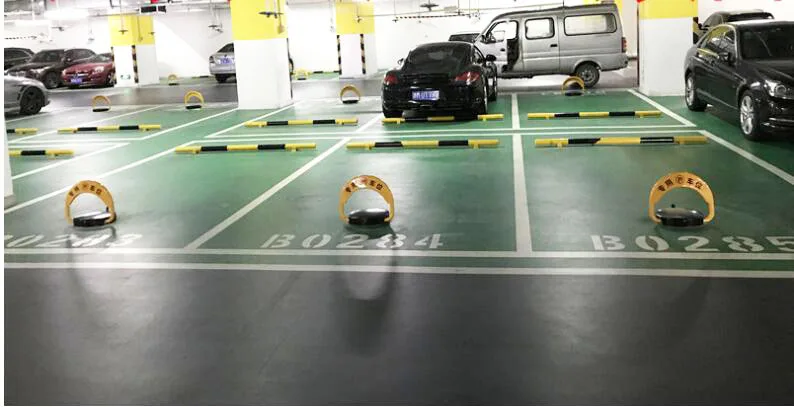
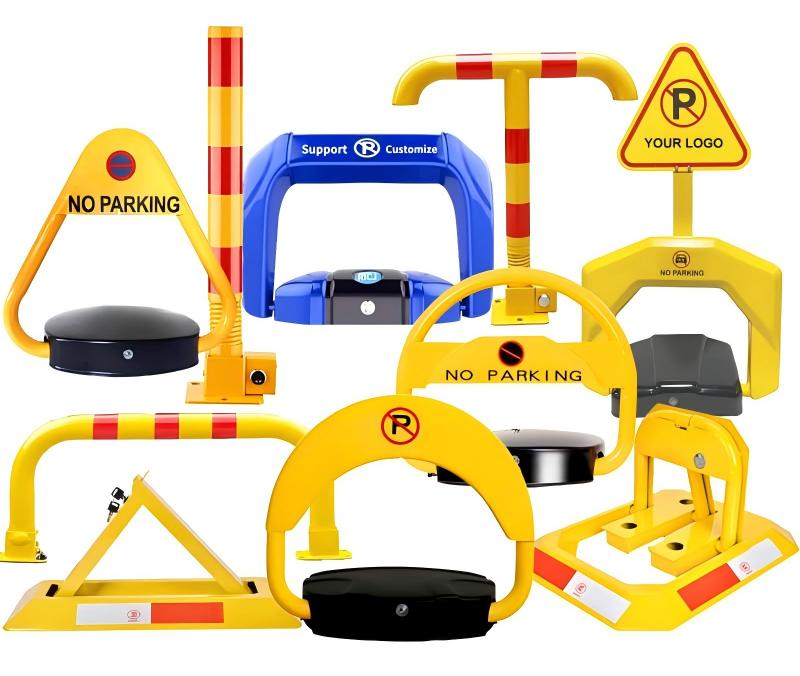
A parking lock is a compact device installed within or around an individual parking space to prevent unauthorized vehicles from occupying it.
It is commonly used for reserved residential spaces, private parking spaces, employee spaces, and other locations where one particular space needs to remain available for an authorized user.
Many automatic parking locks can be raised when the space needs to be reserved and lowered when the owner needs to park. Remote control operation makes this practical for everyday use.
The main function is therefore individual space protection, not traffic management for an entire parking facility.
For more information about operation, installation, and selection factors, see our guide: [Remote Control Automatic Parking Lock: A Practical Guide].
What Is a Parking Barrier?
A parking barrier is designed to control vehicle movement through an entrance or exit rather than protect one specific parking space.
In parking facilities, commercial properties, residential communities, offices, and other controlled-access locations, a barrier can open for authorized vehicles and remain closed when access is restricted.
Unlike a parking lock, a barrier normally serves a shared access point used by multiple vehicles.
Its role is closer to vehicle access management than reserved-space protection.
For example, a parking barrier may be appropriate at the entrance to a parking lot, while a parking lock may be installed in one reserved space inside that parking lot.
Parking Lock vs Parking Barrier: Different Applications
The practical difference becomes much clearer when looking at typical use cases.
| Application | More Suitable |
|---|---|
| Reserved apartment parking space | Parking Lock |
| Private residential parking space | Parking Lock |
| Assigned office parking space | Parking Lock |
| Individual commercial parking space | Parking Lock |
| Parking lot entrance | Parking Barrier |
| Residential community entrance | Parking Barrier |
| Office or commercial driveway | Parking Barrier |
| Controlled vehicle access point | Parking Barrier |
The key is the scale of control.
When only one parking space needs protection, installing an entrance barrier would usually provide more control than the application requires. When dozens or hundreds of vehicles need to be managed through one entrance, a parking lock cannot perform the same access-control role as a barrier.
A Parking Lock Protects a Space. A Barrier Controls an Entrance
Consider a residential property with assigned parking.
Each resident may have a designated space that should remain available for their vehicle. A parking lock can be used directly in that space to discourage unauthorized parking.
Now consider the entrance to the same residential community. The requirement is different. The property manager may need to regulate every vehicle entering or leaving the site. In this situation, an entrance barrier is designed for the job.
The two systems can even be used in the same project:
Parking Entrance → Parking Barrier → Individual Reserved Spaces → Parking Locks
This creates different levels of control instead of trying to make one device perform every function.
Can a Parking Lock Replace a Parking Barrier?
In most cases, no.
The two products are designed around different control areas. A parking lock is intended to protect a specific space, while a parking barrier is intended to regulate vehicle movement through an access point.
Using a parking lock as a substitute for an entrance barrier would not provide the same level of traffic control. Likewise, installing a parking barrier solely to protect one reserved parking space may be unnecessarily complicated for the application.
The right choice starts with identifying where vehicle control is actually needed.
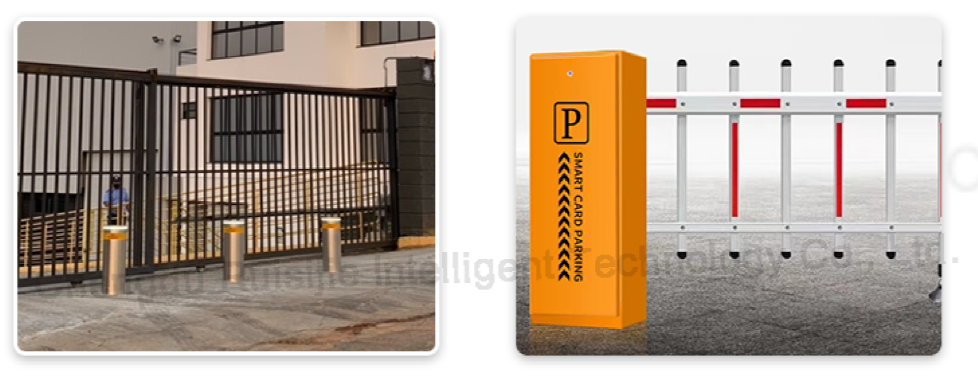
What About Security Bollards?
Parking locks and parking barriers are not the only options for vehicle control.
For projects where the primary objective is to keep vehicles away from a building, pedestrian area, storefront, or protected perimeter, security bollards may be more appropriate.
A simple way to distinguish the main functions is:
| Product | Primary Function |
|---|---|
| Parking Lock | Protect one parking space |
| Parking Barrier | Control an entrance or traffic lane |
| Security Bollard | Create a physical vehicle boundary |
| Road Blocker | Provide lane-level high-security vehicle protection |
This distinction is particularly useful during early project planning. A parking management problem does not necessarily require a high-security barrier, while a vehicle protection project may require more than a parking-control device.
For projects involving deliberate vehicle impact risk, crash-rated bollards or road blockers should be assessed separately based on the required threat level and tested performance.
How to Choose the Right Solution
The selection process becomes much simpler when the control area is defined first.
Individual parking space
→ Parking Lock
Entrance or driveway
→ Parking Barrier
Building or pedestrian boundary
→ Security Bollard
High-security vehicle access point
→ Road Blocker / Crash-Rated System
This approach avoids comparing products that are designed for completely different purposes.
Other project factors, such as operating frequency, site layout, access requirements, environmental conditions, and the required level of vehicle protection, can then be considered after the basic product category has been identified.
Choosing a Parking Security Solution From RICJ
RICJ provides parking and vehicle security equipment for different levels of site control, including automatic parking locks, security barriers, fixed and retractable bollards, and road blockers.
For individual parking spaces, RICJ parking locks provide a compact solution for reserved-space protection and unauthorized parking prevention. For larger access points, barrier systems can be used to manage vehicle entry and exit.
Where stronger physical vehicle protection is required, bollard and road blocker solutions can be considered according to the project's security objectives.
With OEM/ODM capabilities, RICJ can support distributors, contractors, system integrators, and project buyers with customized configurations and technical documentation.
Choose the System Based on the Area You Need to Control
The main difference between a parking lock and a parking barrier is not simply their structure. It is the area and function they are designed to control.
A parking lock is intended to protect an individual parking space. A parking barrier manages vehicle movement through a shared entrance or access point. Security bollards and road blockers serve different roles when stronger physical vehicle protection is required.
Once the control area and security objective are clear, choosing the right equipment becomes much easier.
Need to protect a reserved parking space or control a vehicle entrance? Share your project requirements with RICJ for a suitable parking security solution.
Post time: Sep-20-2026


