
Choosing a flagpole for a commercial, corporate, government, or architectural project involves more than selecting a height and finish. The size of the flag, installation environment, operating method, wind conditions, and foundation all affect the final design.
For projects that require frequent flag changes or convenient ground-level operation, an automatic rising flagpole can be a practical solution. With the lifting mechanism integrated inside the pole, the flag can be raised and lowered without manually operating an external rope system.
This guide covers the main factors buyers should consider before selecting an automatic flagpole, from height and material to installation, operation, and customization.
What Is an Automatic Rising Flagpole?
An automatic rising flagpole uses an internal lifting system to raise and lower the flag. Depending on the configuration, the system may include an internal winch, motor, halyard rope, hanger rod, and control components.
Because the operating mechanism is concealed inside the pole, the exterior maintains a clean appearance. More importantly, the system allows operators to manage the flag from ground level, making it particularly useful for tall installations or locations where flags need to be changed regularly.
For small installations with occasional flag changes, a conventional manual system may be sufficient. For taller commercial, government, corporate, or architectural projects, an automatic system can provide greater convenience.
How to Choose the Right Flagpole Height
Flagpole height should be determined by the surrounding environment rather than simply choosing the tallest available model.
Consider the height of nearby buildings, the viewing distance, the available installation area, and the size of the flag. A flagpole placed at the entrance of a small commercial building may only need a moderate height, while a government facility, corporate headquarters, or landmark project may require a much taller structure.
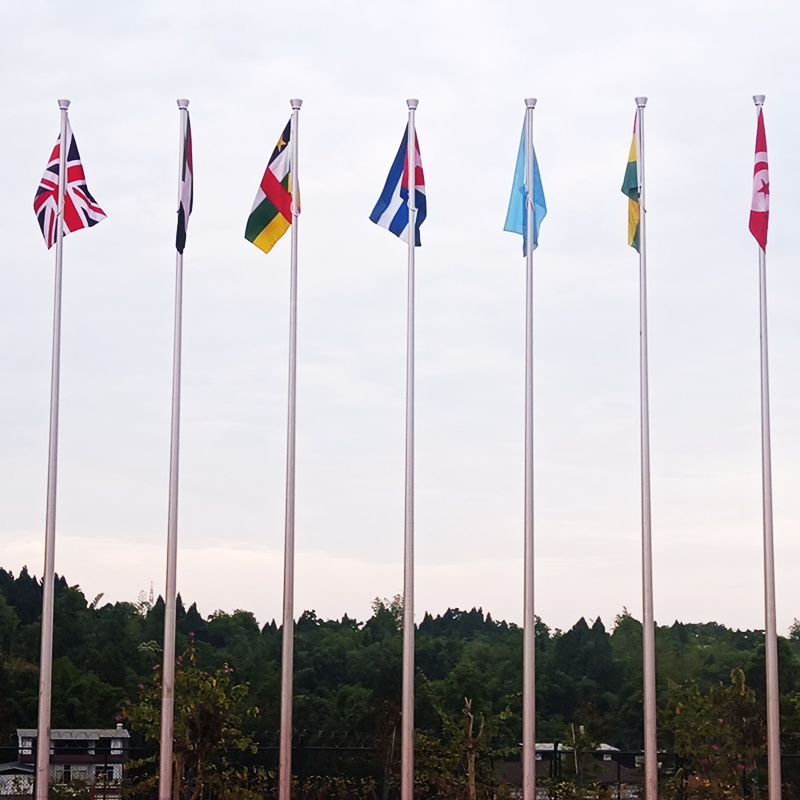
As a general reference, poles around 6–10 meters can suit smaller properties, while larger commercial and institutional projects may require 10–30 meters or more. Architectural and landmark projects can extend to 30–60 meters.
These figures should only be used for preliminary planning. The final height needs to be considered together with flag dimensions, wind conditions, structural requirements, and the installation site.
Flag Size and Wind Conditions
The size of the flag is just as important as the height of the pole. A larger flag creates greater wind loading, particularly in open or exposed locations.
For this reason, the manufacturer should know the approximate flag dimensions before finalizing the pole design. The local wind environment should also be considered. A pole installed in a sheltered urban area may face very different conditions from one installed in a coastal, mountainous, or open public area.
For larger projects, pole diameter, wall thickness, foundation design, and lifting system should be evaluated as part of the same structure rather than selected independently.
Stainless Steel or Aluminum?
Material selection usually comes down to the balance between appearance, weight, environmental conditions, and structural requirements.
Stainless steel is often preferred for premium architectural and commercial applications because of its modern metallic appearance and corrosion resistance. It works particularly well around corporate headquarters, hotels, government buildings, and other high-visibility locations.
Aluminum provides a lighter alternative and can be useful when transportation, handling, and installation weight are important considerations.
There is no single material that is best for every project. The appropriate choice depends on the site and the overall design requirements.
What Does an Automatic Flagpole System Include?
An automatic flagpole is more than the visible pole body. A typical configuration can include an internal winch or motor, halyard rope, hanger rod, finial ball, base plate, and control components.
The exact configuration depends on the pole height, flag dimensions, operating frequency, and project requirements.
When comparing quotations, buyers should therefore check whether the price covers the complete operating system or only the pole itself. This helps avoid unexpected costs when accessories or control components need to be added later.
Installation and Foundation
A suitable foundation is essential for a stable outdoor flagpole, especially for taller installations.
Before production, the project team should consider the available installation area, ground conditions, anchor bolt arrangement, base plate, transportation access, and local construction requirements.
For large poles, the foundation should be designed according to factors such as pole height, wind loading, soil conditions, and the selected anchoring system. The final foundation design should follow the requirements of the specific site and local engineering standards.
When Is Customization Necessary?
Standard flagpoles can work well for straightforward installations, but larger projects often require adjustments to dimensions or appearance.
RICJ can customize the main specifications according to the project, including height, material, profile, wall thickness, finish, lifting system, and accessories. Available heights range from approximately 3 to 60 meters, with stainless steel and aluminum options.
Common profiles include conical, tapered straight, and round straight designs. Finishes such as gold and silver can also be selected according to the architectural style.
Rather than selecting every specification separately, it is better to provide the manufacturer with the complete project requirements so the different components can be matched appropriately.
What Information Should You Provide for a Quotation?
The more project information available at the quotation stage, the easier it is for a manufacturer to recommend a suitable configuration.
At a minimum, buyers should provide the approximate flagpole height, flag dimensions, number of flags, installation location, preferred material, and quantity. If the project is already in the design stage, drawings, site photos, or installation requirements can provide additional information.
For projects where the specifications have not yet been finalized, simply providing the building type, intended application, approximate location, and desired appearance can be a useful starting point.
How to Compare Flagpole Suppliers
Price is important, but it should not be the only factor when comparing suppliers for a customized project.
For a standard small flagpole, product specifications may be enough to make a decision. For larger automatic systems, however, buyers should also consider whether the manufacturer can handle customization, provide technical drawings, configure the lifting system, support installation planning, and supply the required accessories.
Manufacturing experience and previous export projects can also provide useful references when evaluating whether a supplier is suitable for a larger or more complex order.
The goal is to select a supplier that can provide a complete solution rather than simply supplying the metal pole.
Automatic Rising Flagpoles from RICJ
RICJ provides factory-direct automatic rising flagpole solutions for commercial, corporate, government, institutional, and architectural projects.
The flagpoles can be customized according to project requirements, with available heights from approximately 3 to 60 meters and options for stainless steel or aluminum construction. Pole profiles, wall thickness, finishes, internal lifting systems, and accessories can also be configured according to the application.
For a project quotation, buyers can provide the required height, flag dimensions, installation location, quantity, preferred material, and operating requirements. RICJ can then evaluate the project and recommend a suitable configuration.
A well-designed flagpole should balance appearance, structural requirements, ease of operation, installation conditions, and long-term use. Considering these factors together can help buyers select a system that is both practical and appropriate for the project.
Post time: Sep-02-2026


