
Automatic flagpoles can develop problems caused by power supply faults, control issues, cable wear, limit-switch errors, mechanical resistance, or outdoor conditions.
Instead of replacing components immediately, start with the symptom. The table below can help narrow down the likely cause and the next step.
Automatic Flagpole Troubleshooting at a Glance
| Problem | Likely Cause | First Action |
|---|---|---|
| No response | Power, controller, or remote failure | Check power and control signal |
| Motor runs but flag does not move | Cable or lifting mechanism problem | Inspect the lifting system |
| Flag stops halfway | Obstruction, friction, or position setting | Check the lifting path |
| Motor does not stop | Limit switch or position-control fault | Stop operation and inspect |
| Flag moves slowly or makes noise | Mechanical resistance or wear | Check moving components |
| Flag becomes tangled | Cable twisting or incorrect attachment | Stop the system and inspect the flag |
| Fails after rain | Moisture or corrosion | Check enclosure and connections |
1. The Automatic Flagpole Does Not Respond
What you see
The flagpole does not raise or lower, and there is no obvious motor or control response.
Most likely cause
The problem is usually related to the power supply or control system rather than the lifting mechanism.
Check whether the system has power and whether the breaker or protective device has tripped. If the controller is powered, check the remote or control switch and its signal.
2. The Motor Runs but the Flag Does Not Move
What you see
You can hear the motor operating, but the flag remains stationary.
Most likely cause
This usually points to the lifting mechanism. A loose or damaged cable, cable displacement, pulley problem, or drive-mechanism fault can prevent motor movement from reaching the flag.
What to inspect
With power isolated, inspect the accessible lifting components for cable damage, unusual slack, displacement, or obstruction.
Key clue: Motor runs + flag does not move = check the lifting mechanism before replacing the motor.
3. The Flag Stops Halfway
What you see
The flag starts moving normally but stops before reaching the expected position.
How to narrow it down
- [1] Stops at the same height every time?
The limit switch, position sensor, or travel setting may need inspection. - [2] Stops at different positions?
Mechanical resistance, cable twisting, friction, or an obstruction is more likely. - [3] Only happens under certain weather conditions?
Check the flag, cable, and outdoor environment for wind, moisture, or debris.
Avoid repeatedly forcing the motor to overcome resistance. This can increase stress on the lifting system.
4. The Motor Does Not Stop at the End Position
What you see
The flag reaches the top or bottom, but the motor continues running.
Most likely cause
The system may not be receiving the correct end-position signal. Depending on the design, the flagpole may use limit switches, sensors, or another position-control method.
What to do
Stop repeated operation and inspect the position-control system. A faulty device may be caused by:
Sensor / limit switch → wiring → mechanical alignment → controller
Do not continue running the system against the end of its travel.
5. The Flag Moves Slowly or Makes Unusual Noise
What you see
The flag still operates, but movement becomes slower, rougher, or noisier than normal.
Most likely cause
A change in operating performance often points to mechanical resistance or wear.
| Symptom | Possible Direction |
|---|---|
| Slower movement | Friction, cable resistance, motor issue |
| Rubbing sound | Cable or component contact |
| Grinding sound | Mechanical wear or damaged component |
| Rattling | Loose hardware or moving parts |
6. The Flag Becomes Tangled
Common Causes: Cable twisting, incorrect flag attachment, strong wind, or unsuitable flag size.
Do not keep running the motor while the flag is trapped.
7. The Flagpole Stops Working After Rain
Focus Areas: Control enclosure, cable entry points, electrical connections, base area, and drainage.
Look for water accumulation, corrosion, or damaged seals. Do not ignore repeated weather-related faults.
A Simple Way to Diagnose the Problem
You can narrow down most faults by following this order:
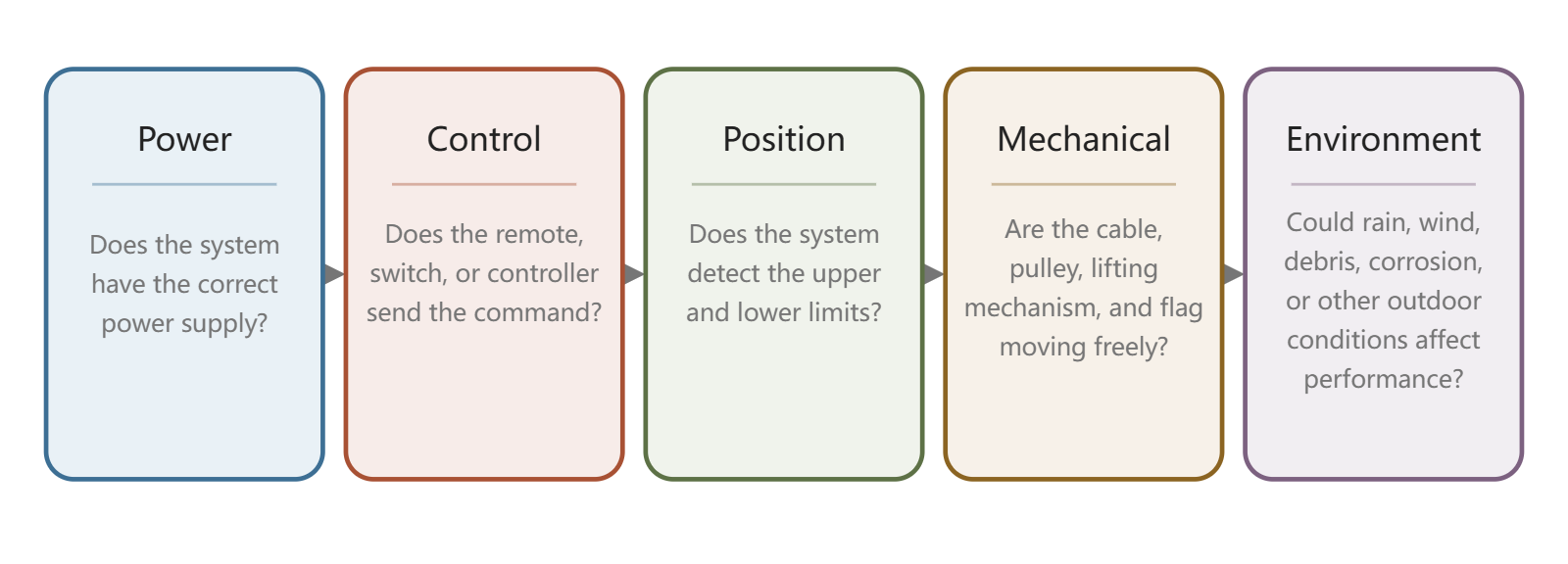
This sequence helps separate electrical problems from mechanical problems.
When Should You Stop Troubleshooting?
Stop operation when you notice:
- Repeated breaker trips
- Burned or exposed wiring
- Water inside the electrical enclosure
- A motor that continues running at the end position
- A broken or severely damaged lifting cable
- Severe grinding or impact noise
- Structural damage to the pole or foundation
Preventing Common Automatic Flagpole Problems
Regular inspection can reduce unexpected downtime.
Pay particular attention to the lifting cable, pulley or drive mechanism, limit system, control enclosure, electrical connections, flag attachment, and drainage around the installation.
Keeping these components clean, correctly aligned, and free from obvious damage can help identify problems before they affect normal operation.
Start with the Symptom, Not the Part
Automatic flagpole problems are often easier to diagnose when you start with the symptom rather than the component.
For safe troubleshooting, always follow the manufacturer's wiring, maintenance, and service instructions for the specific flagpole system.
Post time: Oct-08-2026


