
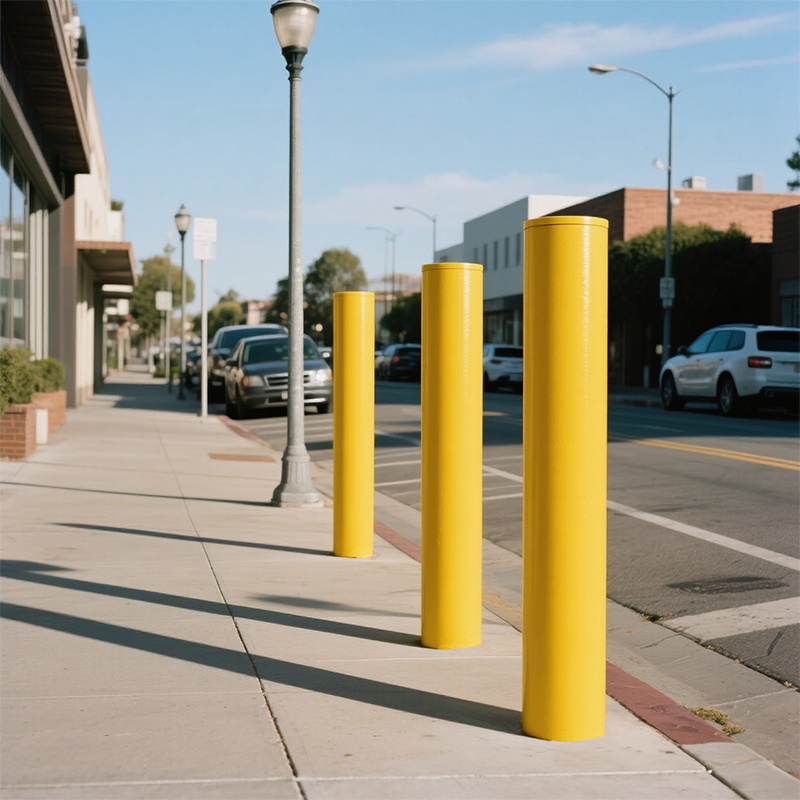
Australian bollards prefer yellow for the following reasons:
1. High visibility
Yellow is a very eye-catching color that can be easily seen by people and drivers in all weather conditions (such as strong sunlight, cloudy days, rain and fog) and light environments (day/night).
The color yellow is highly perceptible to the human eye, second only to white.
At night, with reflective materials, yellow is more likely to be reflected by car lights.
2. Convey warning information
Yellow is often used as a warning color in the field of traffic and safety to remind people of potential dangers or obstacles
Facility such as traffic signs, speed bumps, and warning strips also use yellow.
The function of bollards is often to prevent collisions and prevent vehicles from mistakenly entering pedestrian areas, so the color matching tends to use colors with “warning” meanings.
3. Compliance with standards and specifications
Australia has a series of standards for road and urban planning design, such as AS 1742 (traffic control equipment series standard), which recommends the use of bright colors to improve safety.
Yellow bollards have a strong contrast with the ground and background (such as gray pavement, green space, and walls), which facilitates standardized management.
4. Related to the purpose
Different colors have different functions:
Yellow: commonly used for traffic warnings and safety collision prevention.
Black or gray: more suitable for decorative bollards.
Red and white: may be used for temporary isolation or temporary control.
If you see yellow bollards on Australian streets, parks, schools, shopping malls or parking lots, they may have:
Safety protection function (anti-vehicle collision)
Zone division function (such as no-entry zone)
Visual guidance function (guiding the direction of traffic)
Post time: Jul-25-2025


