
“For museums, safety is the lifeline. My anxieties mainly stem from two aspects: first, how to elegantly and effectively control vehicle access on a daily basis without affecting the visitor experience; and second, whether we have the ability to react correctly in a split second should an emergency occur,” Director Chen stated bluntly.
Pain Point 1: The Contradiction Between “Rigidity” and “Flexibility” in Daily Management
The museum plaza serves as both the visitor entrance and an essential passageway for logistics and firefighting. In the past, using fixed barriers or manual fences either lacked flexibility, hindering emergency vehicles, or required a large number of personnel for monitoring, resulting in inefficient management.
“The automatic hydraulic bollards we’re using now perfectly solve this problem,” Director Chen explained. “During opening hours, they all rise, forming a clear and aesthetically pleasing invisible boundary, preventing any vehicles from accidentally entering or trespassing into the visitor area. This protection is ‘rigid.’ When our artifact transport vehicles or logistics vehicles need to enter at specific times, the central control room or authorized security personnel can remotely lower the designated bollards via remote control. The process is quiet, quick, and doesn’t disturb surrounding visitors. This ‘flexible’ management allows us to achieve precise control.”
Pain Point Two: The Disconnect Between “Decision-Making” and “Execution” in Emergency Situations
A greater anxiety stems from emergency plans. Director Chen frankly admitted that past drills revealed problems: If a fire breaks out inside the museum, fire trucks rush to the scene, but fixed obstacles in the passageways need to be manually moved and cleared, which is time-consuming and chaotic; or if there’s a power outage and electrical equipment malfunctions, the entire entrance could be paralyzed.
“This is precisely the decisive reason why we chose to install the emergency stop button on the hydraulic bollards,” said Director Chen, pointing to a red button with a protective cover on the side of the bollard. “This design gives us ultimate peace of mind. In any situation, whether it’s a system failure or a deliberate power outage, my team can run to the scene, trigger the button with one press, and ensure the bollards lower. It completely bridges the gap between decision-making (the need to open the passage) and execution (immediate physical opening) in an emergency. We’ve tested it, and the time from the alarm sounding to all emergency exit bollards being ready has been reduced by more than two-thirds.”
Core Value: More Than Just Equipment, a Reliable Risk Control Partner
In Director Chen’s view, the value of these automatic hydraulic bollards far exceeds their hardware.
“Its core value lies in providing ‘certainty’,” he summarized. “In daily operations, I am certain it will operate precisely according to instructions; in extreme situations, I am certain it will reliably operate manually. This certainty greatly relieves our management pressure. It is no longer a ‘device’ that needs careful handling, but a trustworthy, silent ‘safety partner.’”
Director Chen specifically mentioned the stability of its hydraulic drive system: “Compared to pure electric systems, hydraulic systems are more powerful and operate more stably. For equipment that needs to serve outdoors for extended periods and withstand potential impacts, its inherent mechanical reliability gives us greater peace of mind. Maintenance personnel also report that its structure is more robust and its maintenance cycle is longer.”
Industry Implications: The Selection Logic of Security Equipment for High-Security Locations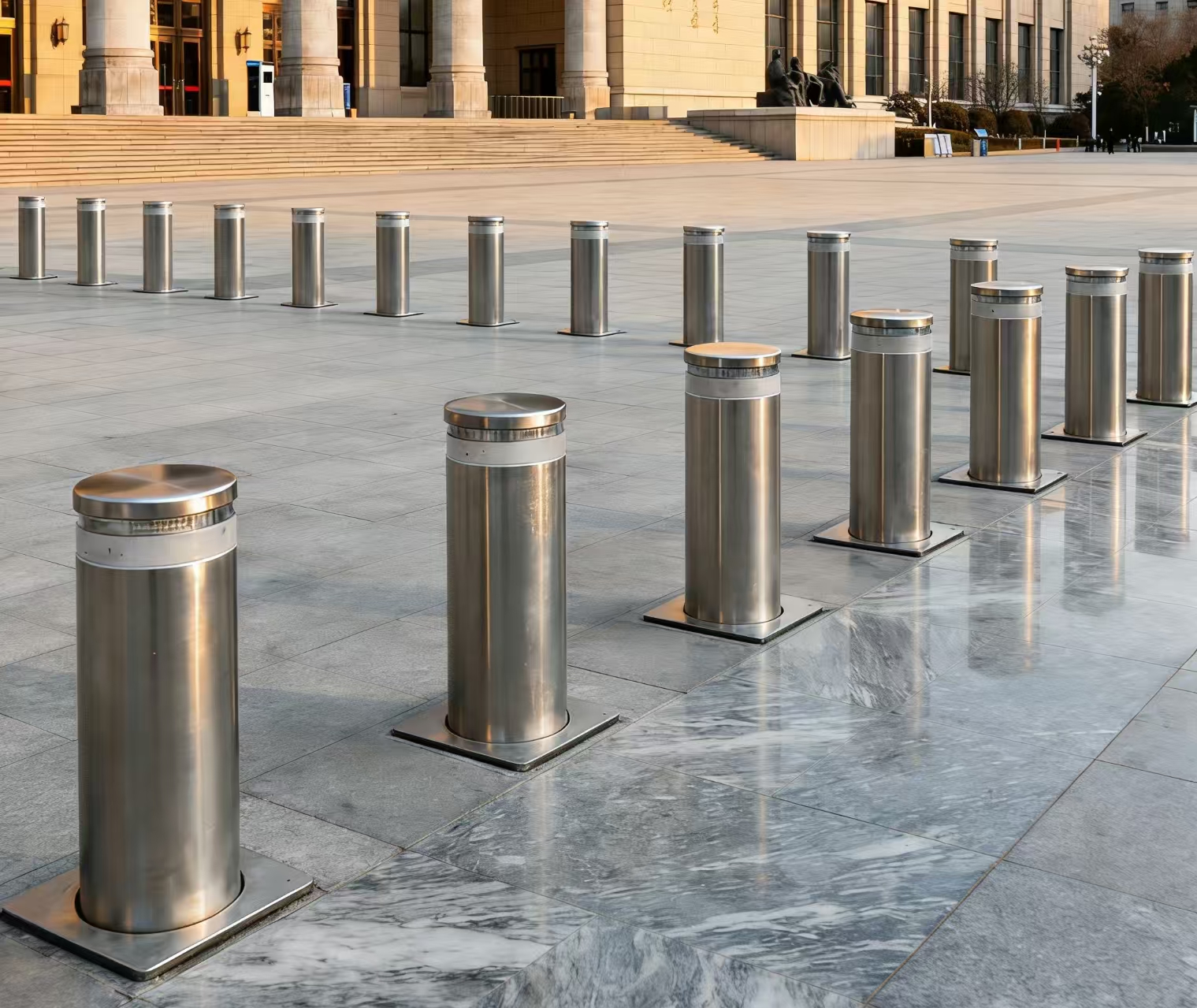
Director Chen’s experience shows that the selection logic for automatic hydraulic bollard systems in high-security locations such as museums, government agencies, nuclear power plants, and data centers is changing:
From “single-point function” to “system disaster recovery”: It’s not just about looking at normal functions, but also examining whether its behavior is safe and controllable under all preset fault modes.
From “Fully Automatic” to “Human-Machine Integration”: Respecting the ultimate human judgment in emergency response, and providing reliable manual override interfaces for automated systems.
From “Purchasing Products” to “Purchasing Guarantee”: The ultimate significance of a product lies in providing solid and reliable physical support for the user’s management goals and emergency plans.
“If your security system collapses immediately after all power cords are unplugged, then it may not be robust enough,” Director Chen concluded. “Our hydraulic bollards, even under such extreme scenarios, remain the last controllable line of defense we can rely on. This is invaluable for organizations bearing significant safety responsibilities.”
(Project Background: The city museum’s security upgrade project deployed 18 RICJ brand LB-101 heavy-duty automatic hydraulic bollards, all equipped with independent emergency buttons and dual-circuit control systems, and linked to the museum’s fire alarm and intrusion alarm systems.)
If you are interested in hydraulic bollards for personal use or for sale, please visit www.cd-ricj.com or contact our team at contact ricj@cd-ricj.com
Post time: Jan-19-2026


