
In front of a government office building in the heart of a city, a joint emergency drill involving multiple departments was underway. The simulated scenario involved a sudden public safety incident, requiring the rapid evacuation of people and vehicles and the sealing off of the area. Upon receiving instructions from the command center, a row of seemingly ordinary automatic hydraulic bollards surrounding the plaza rose steadily within seconds, forming a robust physical barrier. Simultaneously, at the main entrance, security personnel decisively pressed the prominent red emergency buttons next to the bollards, causing the previously raised bollard array to descend, creating an unobstructed passage for emergency vehicles.
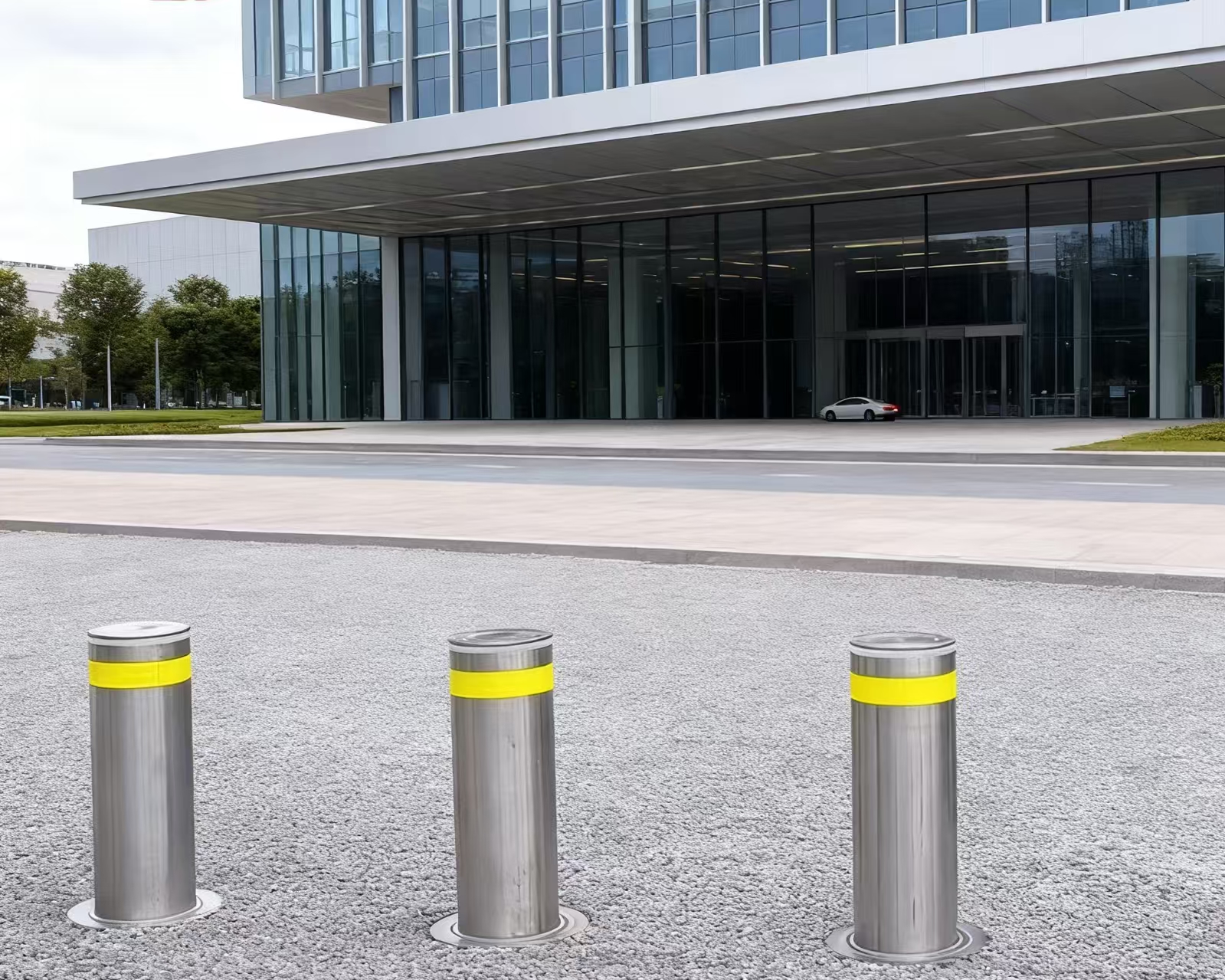
This scene vividly illustrates the evolution of security concepts in modern high-security locations: protection is no longer simply about “closing down the barriers,” but rather about the organic combination of dynamic control, intelligent response, and emergency priority. Automatic hydraulic bollards equipped with emergency buttons are transforming from traditional static barriers into a crucial “intelligent physical node” in the city’s emergency response network.
Technological Evolution: From Passive Isolation to Active, Controllable Access Management
Traditional fixed roadblocks or simple mobile facilities often reveal shortcomings when dealing with real and complex emergency situations: slow response, poor flexibility, and susceptibility to failure in extreme circumstances such as power outages, potentially becoming bottlenecks that delay access. The new generation of intelligent hydraulic bollards, integrating emergency manual control, effectively solves this problem by introducing a “dual-protection” design logic.

Under normal conditions, these hydraulic bollards are centrally dispatched intelligently by a central security system, operating automatically based on license plate recognition, facial recognition gate signals, or pre-set time plans, achieving efficient daily access management. Their core hydraulic drive system provides greater lifting force and operational stability than electric systems, ensuring reliable operation in continuous, high-frequency, or highly challenging scenarios.
Once emergency mode is activated, in cases of system failure, power outage, or situations requiring immediate on-site decision-making, the emergency button becomes the highest priority control terminal. Authorized personnel can force the bollard to rise or fall with a single button press, ensuring absolute control of the emergency access route. This design adds crucial fault tolerance to safety management.
System Integration: Building a Dynamic Security Boundary and Emergency Response Ecosystem
Individual equipment upgrades have limited value; the real breakthrough lies in system integration. As a key execution node in the Internet of Things (IoT), intelligent hydraulic bollards are deeply integrating with a wider range of security and emergency systems.
For example, when a perimeter intrusion alarm system is triggered, the bollards can automatically rise, working in conjunction with audible and visual alarms to create a physical barrier against intrusion. In scenarios requiring rapid flow of people and vehicles, such as after large events, they can be linked with traffic signal systems and smart streetlights to create a “green wave” channel. Furthermore, when fire or medical rescue alarms sound, bollards along the relevant routes can receive signals and automatically lower, simultaneously notifying the security center to open access gates along the route, buying valuable time for rescue efforts.
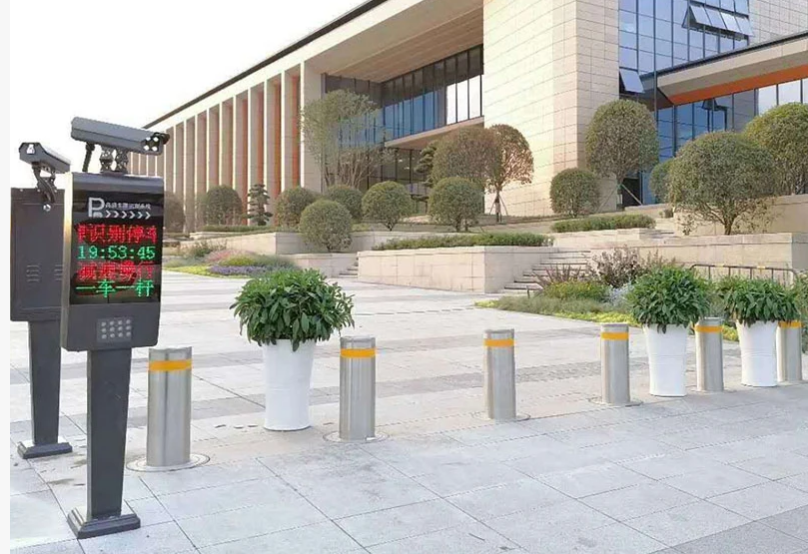
This linkage means that the security boundary is no longer a fixed “line,” but a “domain” that can be dynamically adjusted according to risk level, time schedule, and emergencies. The automatic hydraulic bollards plays the role of an “intelligent joint” controlling the opening and closing of channels.
Future Outlook: Becoming Part of the “Computable Infrastructure” of Smart Cities
As smart city construction deepens, the requirements for the “computability” and “scheduling” of critical infrastructure are becoming increasingly stringent. In the future, by embedding richer sensors (such as pressure sensors and vibration monitoring), the bollards themselves can also become data collection points, providing real-time feedback on vehicle collision attempts, ground flooding, or the equipment’s own health status.
Automatic hydraulic bollards, integrating emergency buttons, intelligent control, and system linkage capabilities, clearly demonstrate that the management of high-security locations is evolving into a comprehensive solution integrating intelligent sensing, real-time analysis, remote control, and emergency manual priority. It is not merely a physical barrier, but a precise embodiment of smart city safety management logic in the physical space, silently safeguarding the bottom line of urban safety operations.
If you are interested in hydraulic bollards for personal use or for sale, please visit www.cd-ricj.com or contact our team at contact ricj@cd-ricj.com
Post time: Jan-07-2026


